An oxygen concentrator works by drawing in room air, compressing it, removing nitrogen through a molecular sieve, and delivering oxygen-enriched air to the user. Most modern units use PSA technology, or pressure swing adsorption, to separate oxygen from nitrogen and provide a stable oxygen flow for medical, veterinary, wellness, or commercial applications.
For distributors, hospitals, clinics, wholesalers, and OEM buyers, understanding the oxygen concentrator working principle is more than a technical detail. It helps you evaluate product quality, oxygen purity, flow stability, after-sales requirements, and long-term reliability before selecting a supplier.
What Is an Oxygen Concentrator?
An oxygen concentrator is an electrically powered device that concentrates oxygen from ambient air. Normal air contains mostly nitrogen and oxygen, along with small amounts of other gases. Instead of storing oxygen like a cylinder, an oxygen concentrator continuously takes in surrounding air and separates oxygen from nitrogen.
This makes the device useful in many settings where oxygen-enriched air is needed, including hospitals, clinics, homecare programs, rehabilitation centers, veterinary hospitals, wellness centers, sports training facilities, and hyperbaric oxygen chamber support systems.
A medical oxygen concentrator is commonly used to provide supplemental oxygen under professional guidance. In B2B procurement, buyers usually compare several factors before purchasing, such as oxygen output, oxygen purity, compressor quality, molecular sieve performance, noise level, duty cycle, safety alarms, certification requirements, and supplier support.
Olive provides different oxygen equipment solutions for B2B customers, including Medical Oxygen Concentrators, Portable Oxygen Concentrators, Pulse Oxygen Concentrators, Veterinary Oxygen Concentrators, Oxygen Concentrators for Hyperbaric Chambers, EWOT Systems, and Hypoxic Generators. Each category has different technical requirements, so understanding how the core oxygen concentration process works is the first step toward choosing the right product.
The oxygen concentrator working principle is based on gas separation. The machine does not create oxygen chemically. Instead, it separates oxygen from the air around us.
A typical oxygen concentrator follows this process:
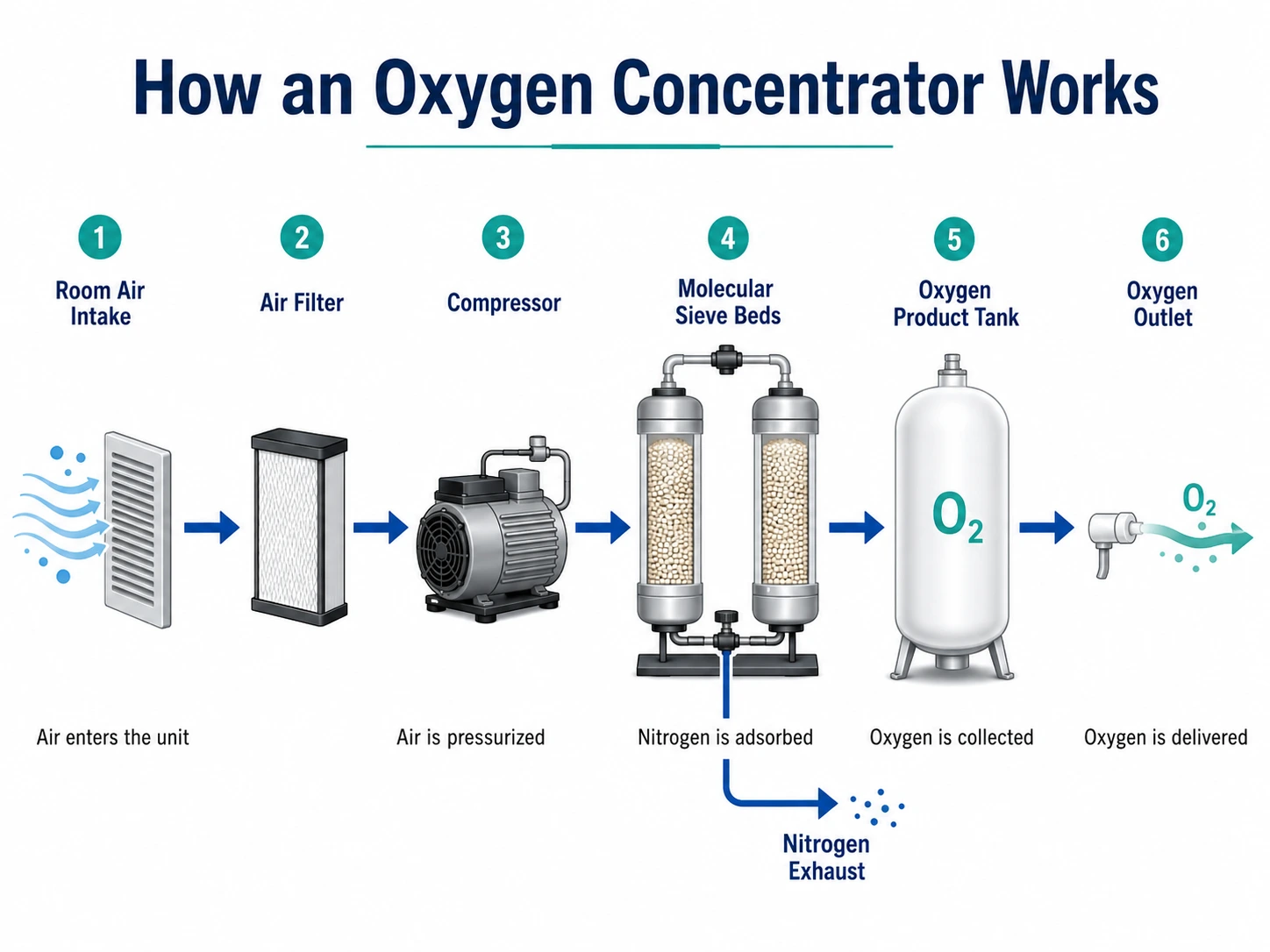
This is why oxygen concentrators are often described as air separation devices. The most common technology used in medical and commercial oxygen concentrators is PSA technology, which stands for pressure swing adsorption.
PSA technology is the heart of most oxygen concentrators. It uses pressure changes to separate gases based on how they interact with adsorbent materials.
In an oxygen concentrator, the adsorbent material is usually a zeolite-based molecular sieve. Under pressure, this sieve attracts and holds nitrogen molecules. Oxygen molecules pass through more easily. When the pressure is released, the trapped nitrogen is discharged back into the surrounding air.
Most oxygen concentrators use two sieve beds. While one sieve bed is adsorbing nitrogen and producing oxygen-enriched gas, the other is depressurizing and releasing nitrogen. The machine alternates between these two beds many times per minute.
This cycling process allows the concentrator to provide a continuous supply of oxygen-enriched air.
| PSA Stage | What Happens | Why It Matters |
|---|---|---|
| Air intake | Room air enters the device through an inlet filter. | Protects internal components from dust and larger particles. |
| Compression | The compressor pressurizes the filtered air. | Pressure is needed for effective nitrogen adsorption. |
| Adsorption | Air enters the molecular sieve bed. | Nitrogen is captured while oxygen passes through. |
| Oxygen collection | Oxygen-enriched gas moves to a product tank or outlet. | Helps stabilize oxygen flow and purity. |
| Desorption | Pressure drops in the used sieve bed. | Trapped nitrogen is released. |
| Cycling | The device switches between sieve beds. | Allows continuous or near-continuous oxygen production. |
For B2B buyers, PSA performance affects oxygen purity, stability, power consumption, noise, heat, and long-term reliability. A concentrator with poor PSA design may show unstable purity, reduced flow, overheating, or more frequent service requirements.
The molecular sieve is one of the most important components in an oxygen concentrator. It is usually made from zeolite material, which has tiny pores and strong adsorption properties.
In simple terms, the molecular sieve acts like a selective filter. It does not work like a paper filter that blocks large particles. Instead, it separates gases based on adsorption behavior. Under pressure, nitrogen molecules are held by the sieve, while oxygen molecules pass through.
The performance of the molecular sieve directly affects oxygen purity. If the sieve is high quality and the system is well designed, the concentrator can maintain stable oxygen concentration within its rated flow range. If the sieve becomes contaminated by moisture, oil vapor, dust, or long-term degradation, oxygen purity may decline.
For clinics, hospitals, distributors, and OEM buyers, molecular sieve quality is especially important because it influences:
This is one reason serious B2B buyers should evaluate more than the outer appearance of a machine. Two oxygen concentrators may look similar, but their internal compressor, valve system, sieve material, cooling design, and quality control process can be very different.
Although oxygen concentrators vary by size and application, most include several core components.
| Component | Function | B2B Buying Consideration |
|---|---|---|
| Air inlet filter | Removes dust and larger particles from incoming air. | Easy filter access helps reduce maintenance issues. |
| Compressor | Pressurizes room air before separation. | Affects noise, durability, power use, heat, and duty cycle. |
| Heat management system | Helps cool internal components. | Important for hospitals, clinics, and continuous operation. |
| Molecular sieve beds | Adsorb nitrogen and allow oxygen to pass through. | Critical for oxygen purity and long-term performance. |
| Solenoid valves | Control air direction and PSA cycling. | Valve quality affects stability, service life, and noise. |
| Product tank | Stores oxygen-enriched gas temporarily. | Helps stabilize flow and concentration. |
| Flow control system | Regulates oxygen output. | Must match clinical, veterinary, or equipment requirements. |
| Oxygen sensor | Monitors oxygen concentration in many models. | Useful for safety, maintenance, and professional use. |
| Alarm system | Alerts users to low oxygen, power failure, overheating, or pressure problems. | Important for medical and institutional environments. |
| User interface | Displays settings, alarms, and operating status. | Clear controls reduce training burden for end users. |
For a medical oxygen concentrator, safety alarms and oxygen concentration monitoring are especially important. For a portable oxygen concentrator, battery performance, weight, pulse dose sensitivity, and portability are also major considerations. For veterinary or hyperbaric support use, stable output and compatibility with connected systems may be more important than portability.
To understand how an oxygen concentrator works in real operation, let’s follow the process from air intake to oxygen delivery.
The device pulls in ambient air through an inlet. Since surrounding air contains dust, hair, and particles, the air first passes through filters. These filters help protect the compressor and sieve beds.
In B2B use, filter design matters. Clinics, veterinary hospitals, rehabilitation centers, and homecare rental companies may operate concentrators in different environments. Easy-to-clean or easy-to-replace filters reduce service time.
After filtration, the air enters the compressor. The compressor increases air pressure so that PSA separation can occur.
The compressor is one of the hardest-working components in the device. Its quality affects noise level, heat generation, operating life, and maintenance frequency. For distributors and wholesalers, compressor durability can strongly influence after-sales support costs.
The compressed air flows into a sieve bed filled with molecular sieve material. Under pressure, nitrogen is adsorbed by the sieve. Oxygen passes through and moves toward the product tank or outlet.
This is the key separation stage. The device is not adding oxygen to air. It is removing much of the nitrogen, which increases the oxygen concentration of the remaining gas.
The oxygen-enriched gas is temporarily stored in a product tank or stabilization chamber. This helps smooth out pressure changes from PSA cycling and supports more stable delivery.
For a continuous flow oxygen concentrator, this stability is important because the machine must provide a set flow rate, such as 1 LPM, 3 LPM, 5 LPM, 8 LPM, or 10 LPM, depending on the model.
Once a sieve bed becomes saturated with nitrogen, the system reduces pressure in that bed. The trapped nitrogen is released back into the surrounding air through an exhaust outlet.
At the same time, the second sieve bed is producing oxygen-enriched gas. This alternating process allows oxygen production to continue.
Finally, oxygen-enriched gas exits the concentrator through the outlet. Depending on the application, it may be delivered through:
For medical use, oxygen flow and use duration should follow a doctor’s or qualified healthcare professional’s guidance. For veterinary use, oxygen therapy should be guided by a licensed veterinarian. For wellness and sports applications, equipment should be used according to professional guidance and local regulations.
Oxygen purity is one of the most important specifications when evaluating an oxygen concentrator. In many concentrators, oxygen concentration is commonly designed around approximately 90% or higher within the rated flow range. However, actual purity depends on the machine design, flow setting, sieve condition, altitude, maintenance, operating temperature, and product quality.
A key point for buyers: oxygen purity should be evaluated at the rated flow rate, not only at the lowest flow setting.
For example, a 10 LPM oxygen concentrator should be assessed at or near 10 LPM if that is the intended use. Some machines may show acceptable purity at low flow but drop significantly at higher output.
| Factor | Impact on Oxygen Purity | Buyer Tip |
|---|---|---|
| Flow rate | Higher flow settings may reduce concentration if the system is underpowered. | Check purity at rated maximum flow. |
| Molecular sieve quality | Poor sieve material can reduce separation efficiency. | Ask about sieve source, lifespan, and replacement support. |
| Compressor performance | Weak compression reduces PSA effectiveness. | Evaluate compressor durability and service history. |
| Air leakage | Leaks can reduce pressure and concentration. | Check assembly quality and pressure testing process. |
| Filter maintenance | Dirty filters restrict airflow. | Choose models with accessible filters and clear maintenance guidance. |
| Humidity and contamination | Moisture or oil can damage sieve performance. | Use devices in suitable environments and maintain filters. |
| Altitude | Higher altitude may affect output and concentration. | Confirm suitability for the target market’s operating conditions. |
| Heat management | Excessive heat may reduce component life. | Review cooling design for continuous-use environments. |
For B2B procurement, oxygen purity stability is often more important than a single laboratory value. Distributors and clinics need machines that perform consistently over time, especially in high-duty applications.
One of the most common buyer questions is whether to choose a continuous flow oxygen concentrator or a pulse oxygen concentrator.
A continuous flow oxygen concentrator delivers oxygen at a steady flow rate, whether the user is inhaling or exhaling. This type is common in medical facilities, homecare, veterinary oxygen systems, hyperbaric support, and many fixed-location applications.
A pulse oxygen concentrator delivers oxygen in short bursts when it detects inhalation. This design helps conserve oxygen and battery power, making it common in portable oxygen concentrators.
| Feature | Continuous Flow Oxygen Concentrator | Pulse Oxygen Concentrator |
|---|---|---|
| Delivery method | Provides constant oxygen flow. | Delivers oxygen when inhalation is detected. |
| Common use | Clinics, hospitals, homecare, veterinary systems, hyperbaric support. | Portable oxygen use, mobility-focused applications. |
| Power demand | Usually higher. | Usually lower due to oxygen conservation. |
| Battery suitability | Less suitable for small batteries. | More suitable for portable battery-powered units. |
| Flow measurement | Liters per minute, such as 5 LPM or 10 LPM. | Pulse dose settings vary by manufacturer. |
| Best for | Stable oxygen supply and equipment connection. | Mobility and oxygen conservation. |
| Buying concern | Purity at maximum flow and continuous duty cycle. | Trigger sensitivity, bolus size, battery life, and user compatibility. |
For medical use, the correct flow type should be selected according to professional guidance. Pulse dose settings are not always equivalent to continuous flow LPM values. This is an important detail for distributors and dealers, because misunderstanding this difference can lead to unsuitable product recommendations.
Olive offers oxygen concentrator solutions for different use cases, including continuous flow oxygen concentrators for stable oxygen supply and pulse oxygen concentrators for portable and mobility-focused needs.
A medical oxygen concentrator and a portable oxygen concentrator may use similar PSA principles, but they are designed for different priorities.
A medical oxygen concentrator is usually designed for stable output, longer operating time, and fixed-location use. It may be used in hospitals, clinics, homecare settings, rehabilitation centers, and other healthcare environments. These models often focus on oxygen purity stability, alarm functions, continuous flow capacity, and durability.
A portable oxygen concentrator is designed for mobility. It is usually smaller, lighter, and battery-powered. Many portable models use pulse dose delivery to conserve power. Portable devices may be suitable for users who need oxygen support while moving, traveling, or performing daily activities, subject to professional guidance.
| Category | Medical Oxygen Concentrator | Portable Oxygen Concentrator |
|---|---|---|
| Main purpose | Stable oxygen supply in fixed locations. | Mobility and travel-friendly oxygen support. |
| Typical flow type | Continuous flow; some models may support multiple modes. | Often pulse dose; some larger models may include continuous flow. |
| Power source | AC power. | Battery, AC, and DC power options. |
| Weight | Usually heavier. | Usually lighter. |
| Output capacity | Often higher. | Usually lower than stationary units. |
| Common buyers | Clinics, hospitals, homecare dealers, distributors. | Homecare dealers, mobility equipment distributors, retail medical channels. |
| Main evaluation point | Stability, duty cycle, alarms, purity. | Battery life, weight, trigger sensitivity, portability. |
For wholesalers and OEM buyers, the product category should match the customer scenario. Selling a portable oxygen concentrator into a use case that requires stable high-flow continuous oxygen may create performance problems. Selling a large stationary unit into a mobility-focused channel may reduce customer satisfaction.
Oxygen concentrators and oxygen cylinders both provide oxygen, but they work very differently.
An oxygen cylinder stores compressed oxygen. Once the cylinder is empty, it must be refilled or replaced. An oxygen concentrator does not store a large amount of oxygen. It continuously produces oxygen-enriched gas from ambient air as long as it has power and is operating correctly.
| Feature | Oxygen Concentrator | Oxygen Cylinder |
|---|---|---|
| Oxygen source | Concentrates oxygen from air. | Stores compressed oxygen. |
| Refills | No regular oxygen refill needed. | Requires refill or replacement. |
| Power requirement | Needs electricity or battery. | Does not need electricity for basic use. |
| Portability | Depends on model. Portable units are available. | Small cylinders are portable but limited by capacity. |
| Long-term cost | May reduce refill logistics. | Ongoing refill and delivery cost. |
| Maintenance | Requires filters, cleaning, service checks. | Requires pressure safety management and refills. |
| Best suited for | Continuous supply where power is available. | Backup, emergency, or locations without power. |
For institutions, the decision is not always “one or the other.” Many clinics, hospitals, and homecare programs use concentrators as a primary oxygen source and cylinders as backup. B2B buyers should evaluate power reliability, emergency needs, logistics cost, user training, and local regulations.
Oxygen concentrators are used across multiple sectors. The best product choice depends on the oxygen flow requirement, mobility needs, operating environment, and connection method.
Hospitals and clinics may use oxygen concentrators in departments or settings where centralized oxygen supply is unavailable, limited, or needs backup support. A medical oxygen concentrator can provide oxygen-enriched gas for appropriate use cases under healthcare guidance.
Important considerations include stable oxygen purity, low noise, alarms, serviceability, and compatibility with facility protocols.
Homecare dealers often need reliable, easy-to-use concentrators with clear displays, strong packaging, spare parts support, and manageable after-sales service. For this channel, both stationary medical oxygen concentrators and portable oxygen concentrators may be relevant.
Veterinary oxygen concentrators are commonly used to support oxygen cages, anesthesia recovery areas, and animal care environments under veterinary supervision. Veterinary applications may require stable flow, simple operation, and compatibility with oxygen enclosures or tubing systems.
Some hyperbaric chamber systems use oxygen concentrators as a support oxygen source. In this application, output stability, oxygen concentration, flow capacity, and equipment compatibility are critical. Buyers should confirm the requirements of the chamber system before selecting a concentrator.
EWOT stands for Exercise With Oxygen Therapy. EWOT systems are commonly used in wellness, fitness, and sports performance environments. These applications often require higher oxygen output, reservoir bags, masks, and safe system design. Claims should be made carefully, and use should follow professional guidance.
A hypoxic generator is different from an oxygen concentrator. While an oxygen concentrator increases oxygen concentration, a hypoxic generator reduces oxygen concentration to simulate altitude conditions for training or research settings. Some buyers compare these systems because both involve air separation technology.
B2B buyers often compare oxygen concentrators based on price and flow rate alone. That can lead to poor procurement decisions. Here are common mistakes to avoid.
A machine labeled as 10 LPM is not automatically better than a 5 LPM machine. Buyers should check whether the unit maintains suitable oxygen purity at the rated flow. A high-flow specification with unstable purity may not meet professional requirements.
Pulse dose settings are not the same as continuous flow liters per minute. A pulse setting of “3” does not necessarily equal 3 LPM. Each manufacturer may define pulse settings differently. Dealers should explain this clearly to customers.
The molecular sieve is central to PSA performance. Low-quality sieve material may reduce oxygen concentration stability and shorten product life. For rental fleets, clinics, and distributors, this can increase service costs.
In clinics, wards, homecare bedrooms, veterinary spaces, and wellness centers, noise and heat matter. A device that performs well in a short test may become problematic in long-duration use if cooling design is weak.
Portable oxygen concentrators are valuable for mobility, but many are not designed for high-flow continuous output. For clinics, veterinary cages, hyperbaric chamber support, or EWOT systems, a continuous flow oxygen concentrator may be more suitable.
Distributors and OEM buyers should ask about filters, sieve beds, compressors, valves, sensors, tubing, packaging, user manuals, technical training, and warranty support. A low purchase price may become expensive if spare parts are difficult to obtain.
Medical oxygen equipment may need specific documentation, labeling, testing, or regulatory approval depending on the target market. Buyers should confirm local requirements before importing, distributing, or branding oxygen concentrators.
Choosing the right oxygen concentrator depends on application, output requirements, operating environment, and business model. A distributor serving homecare users may need a different product mix from a veterinary hospital supplier or hyperbaric chamber manufacturer.
Start by identifying the use case. Is the product intended for a clinic, hospital, homecare program, veterinary oxygen cage, portable oxygen user, EWOT system, or hyperbaric chamber support?
Each application has different priorities:
| Application | Recommended Focus |
|---|---|
| Clinic or hospital | Oxygen purity, alarms, continuous operation, easy cleaning, serviceability. |
| Homecare distribution | User-friendly controls, quiet operation, spare parts, packaging, training materials. |
| Portable oxygen channel | Battery life, weight, pulse dose sensitivity, charging options. |
| Veterinary hospital | Flow stability, cage compatibility, durable operation, simple maintenance. |
| Hyperbaric chamber support | Output capacity, system compatibility, continuous flow, safety design. |
| EWOT system | Higher oxygen output, reservoir compatibility, mask/tubing setup. |
| OEM/private label | Customization, documentation, stable manufacturing, quality control. |
Decide whether the target customer needs continuous flow, pulse dose, or both. For professional and equipment-connected applications, continuous flow is often preferred. For mobility, pulse oxygen concentrators are often more practical.
Ask for oxygen purity performance at the maximum rated flow, not only at low flow. For example, if evaluating a 10 LPM machine, request performance information at 10 LPM.
The compressor and molecular sieve system are the core of the machine. For distributors, these components affect return rates, warranty costs, and customer experience.
Useful questions include:
Depending on the application, important alarms may include:
For medical and institutional environments, alarm design should be easy to understand and difficult to ignore.
Noise level can affect customer satisfaction. This is especially important for homecare bedrooms, clinics, rehabilitation rooms, veterinary wards, and wellness centers.
Other user experience factors include display clarity, knob or button quality, handle design, caster movement, tubing connection, humidifier bottle position, and filter access.
For B2B buyers, maintenance is a business issue, not only a technical issue. A machine that is easy to service can reduce warranty costs and improve channel reputation.
Ask suppliers about:
A wholesaler may prioritize stable bulk supply and pricing. A clinic may prioritize reliability and documentation. An OEM buyer may need branding, customization, and long-term production consistency.
Olive works with B2B customers across multiple oxygen equipment categories and can support product selection based on flow, application, use environment, and channel needs.
Need help selecting the right oxygen concentrator for your market?
Olive supports distributors, clinics, hospitals, wholesalers, and OEM buyers with oxygen concentrator solutions for medical, portable, veterinary, wellness, and equipment-integration applications. Share your target flow rate, application, and market requirements to get a suitable product recommendation.
The performance of an oxygen concentrator depends not only on the machine design but also on supplier capability. B2B buyers should evaluate whether the supplier understands technical requirements, provides consistent production quality, and supports after-sales needs.
A reliable supplier should offer clear product specifications, practical application guidance, stable manufacturing, responsive communication, and spare parts support. For OEM buyers, the supplier should also understand packaging, branding, documentation, and repeat-order consistency.
| Evaluation Area | What to Check | Why It Matters |
|---|---|---|
| Product range | Medical, portable, pulse, veterinary, EWOT, hyperbaric support options. | Helps match different customer segments. |
| Technical knowledge | Clear explanation of PSA technology, oxygen purity, and flow type. | Reduces wrong product selection. |
| Quality control | Testing for oxygen concentration, pressure, alarms, and operation. | Supports stable performance. |
| Documentation | User manuals, specifications, labels, and service guidance. | Helps distributors and institutional buyers. |
| Spare parts | Filters, sieve beds, valves, compressors, sensors. | Reduces downtime and after-sales pressure. |
| OEM support | Branding, packaging, customization options. | Useful for private-label buyers. |
| Communication | Fast and practical pre-sales and after-sales response. | Improves procurement efficiency. |
Olive’s product range is designed to support different B2B channels, from medical oxygen concentrator distribution to veterinary oxygen systems, EWOT solutions, and oxygen support for hyperbaric chamber applications.
Looking for OEM or wholesale oxygen concentrator supply?
Olive can help you compare flow capacity, oxygen purity, continuous flow and pulse options, product configuration, and target-market suitability. Contact Olive to discuss distributor pricing, OEM requirements, or product matching for your customer base.
A small clinic wants oxygen concentrators for treatment rooms. The main priorities are stable oxygen purity, continuous flow, safety alarms, easy operation, and low maintenance. In this case, a stationary medical oxygen concentrator is usually more appropriate than a portable pulse unit.
A homecare dealer may need both stationary and portable models. Stationary medical oxygen concentrators can serve users who need fixed-location oxygen support, while portable oxygen concentrators can serve mobility-focused users. The dealer should train sales staff to explain the difference between continuous flow and pulse dose.
A veterinary hospital may need oxygen concentrators to support oxygen cages or animal recovery areas. The buyer should confirm required flow rate, cage size, connection type, and operating duration. A veterinary oxygen concentrator solution should be selected with veterinary guidance.
A wellness center or sports training facility may need an EWOT system with an oxygen concentrator, reservoir bag, tubing, and mask. The buyer should focus on output capacity, system design, user instructions, and responsible marketing language.
A hyperbaric chamber supplier may need compatible oxygen concentrators for chamber support. The buyer should confirm flow rate, oxygen concentration, connection method, chamber requirements, and safety design before purchasing.
Many B2B buyers compare 5 LPM and 10 LPM oxygen concentrators. The right choice depends on application, not only size.
| Factor | 5 LPM Oxygen Concentrator | 10 LPM Oxygen Concentrator |
|---|---|---|
| Typical use | Homecare, small clinics, basic oxygen support. | Clinics, veterinary, EWOT, higher-flow applications. |
| Size and weight | Usually smaller and lighter. | Usually larger and heavier. |
| Power consumption | Generally lower. | Generally higher. |
| Heat output | Lower. | Higher due to larger compressor demand. |
| Noise | Often lower, depending on design. | May be higher, depending on design. |
| Application flexibility | Suitable for lower-flow needs. | Better for higher-flow or equipment-connected use. |
| Buyer concern | Confirm purity across common flow settings. | Confirm purity and stability at maximum flow. |
A 10 LPM unit can be useful for professional and commercial applications, but it should be evaluated carefully. A high-flow concentrator needs a strong compressor, effective cooling, reliable sieve beds, and stable pressure control.
Proper maintenance helps maintain oxygen purity, airflow, and device lifespan. Maintenance requirements vary by model, so users should follow the manufacturer’s manual. However, several general practices are common.
| Maintenance Task | Purpose | Typical B2B Importance |
|---|---|---|
| Clean external filter | Maintains air intake and protects the compressor. | Reduces service calls. |
| Replace internal filters | Protects sieve beds and air pathway. | Helps maintain performance. |
| Check oxygen purity | Confirms device output remains within expected range. | Important for clinics and rental fleets. |
| Inspect tubing | Prevents leaks and flow restriction. | Improves user experience. |
| Keep vents clear | Prevents overheating. | Supports continuous operation. |
| Monitor alarms | Identifies pressure, power, or oxygen issues. | Improves safety and service response. |
| Service compressor or sieve beds | Restores performance when components age. | Extends product life. |
For distributors, a clear maintenance guide can reduce customer complaints. For clinics and hospitals, maintenance should be included in equipment management procedures. For OEM buyers, serviceability should be evaluated before placing large orders.
Want a product recommendation for your oxygen equipment project?
Send ZZOlive your required flow rate, application, target market, quantity, and whether you need OEM branding. The ZZOlive team can help match you with medical oxygen concentrators, portable oxygen concentrators, veterinary oxygen solutions, EWOT systems, or hyperbaric oxygen support equipment.
Olive focuses on oxygen equipment solutions for B2B customers, including distributors, clinics, hospitals, wholesalers, OEM buyers, wellness centers, veterinary hospitals, and commercial equipment purchasers.
For buyers who are comparing suppliers, Olive can help clarify important selection points such as:
Olive solutions include:
The goal is not simply to supply a machine, but to help B2B buyers select equipment that fits the intended use, market requirements, and long-term service expectations.
An oxygen concentrator draws in room air, compresses it, removes much of the nitrogen through a molecular sieve, and delivers oxygen-enriched air. Most concentrators use PSA technology, which separates gases through pressure changes and adsorption.
PSA technology means pressure swing adsorption. In oxygen concentrators, PSA uses pressurized air and molecular sieve material to adsorb nitrogen while allowing oxygen to pass through. The system alternates between sieve beds to provide continuous oxygen production.
The molecular sieve captures nitrogen from compressed air. This allows oxygen-enriched gas to pass through and be delivered from the concentrator. The quality and condition of the molecular sieve have a major effect on oxygen purity and device performance.
Many oxygen concentrators are designed to provide approximately 90% or higher oxygen concentration within their rated flow range. Actual performance depends on flow setting, machine design, sieve quality, altitude, maintenance, and operating conditions. Buyers should check purity at the rated maximum flow.
A continuous flow oxygen concentrator delivers oxygen at a constant flow rate. A pulse oxygen concentrator delivers oxygen in bursts when inhalation is detected. Continuous flow is common for fixed-location and equipment-connected use, while pulse flow is common in portable oxygen concentrators.
In many settings, oxygen concentrators can reduce the need for frequent cylinder refills because they produce oxygen-enriched air from room air. However, cylinders may still be used as backup or for emergency situations. Buyers should evaluate power availability, safety requirements, and local regulations.
Distributors should evaluate product quality, oxygen purity stability, compressor and molecular sieve performance, spare parts availability, documentation, OEM options, warranty support, and supplier communication. Price matters, but long-term reliability and service support are often more important.