For buyers comparing portable oxygen equipment, maximum flow can be surprisingly difficult to interpret. Product pages may advertise settings of 5, 9 or even 10, but these numbers often describe pulse-dose settings, not continuous oxygen flow in liters per minute.
As of July 2026, 3 LPM is generally the highest continuous-flow output found in widely marketed battery-powered portable or transportable oxygen concentrators. Models reaching this level include the CAIRE Eclipse 5 and the Oxlife Independence. Both deliver continuous flow from 0.5 to 3 LPM, but they are considerably heavier than small shoulder-carried pulse-dose concentrators.
This distinction matters for distributors, clinics and homecare providers. The highest number on a control panel does not automatically indicate the highest oxygen output, and a 3 LPM transportable unit may serve a very different use case from a lightweight pulse-only portable concentrator.
A 3 LPM portable oxygen concentrator continuously supplies up to three liters of concentrated oxygen per minute. Oxygen continues to flow during both inhalation and exhalation rather than being released only when the device detects a breath.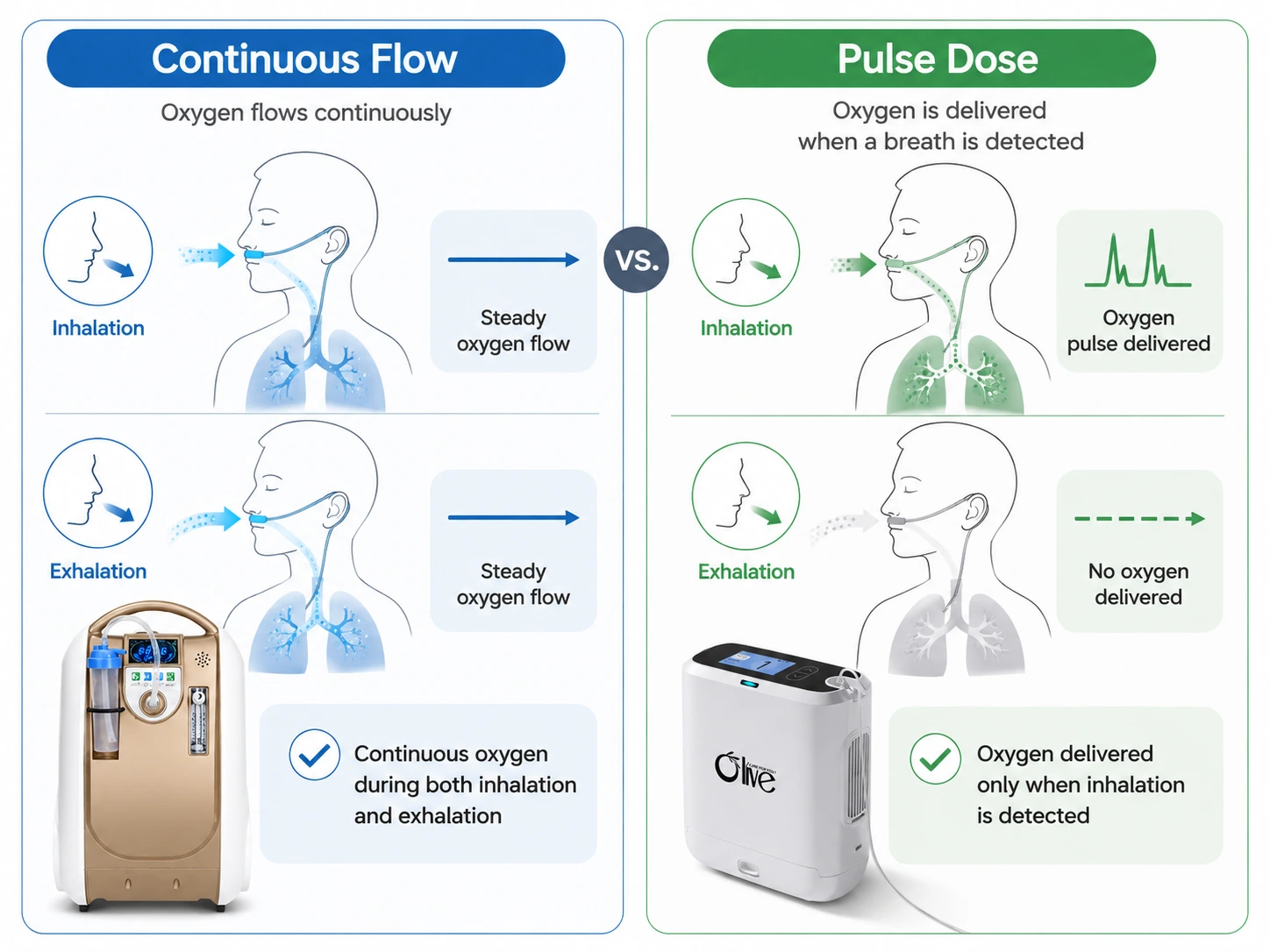
In the current battery-powered POC category, 3 LPM represents the practical upper end of continuous-flow output. For example:
However, “highest” does not mean “best for every user.” Oxygen flow and delivery mode should be selected according to a prescription or qualified clinical assessment. A buyer should never increase flow simply because a device offers a higher setting.
Comparing continuous-flow equipment for a clinic, rental fleet or distribution business? Send Olive your required flow range, power configuration, order quantity and destination market for a specification-based recommendation.
Equipment descriptions frequently use portable and transportable interchangeably, but these terms can represent different levels of mobility.
| Equipment class | Typical mobility | Common delivery capability | Best suited to |
|---|---|---|---|
| Wearable POC | Carried in a shoulder bag or backpack | Usually pulse dose; some models offer up to 1.5–2 LPM continuous flow | Walking, errands and frequent daily movement |
| Transportable POC | Moved on a wheeled cart | Continuous flow up to 3 LPM plus pulse mode | Homecare, travel, discharge and day/night use |
| Stationary concentrator | Installed near a bed, chair or treatment area | Commonly 3–10 LPM or more | Fixed-site, long-duration and higher-flow operation |
The CAIRE Eclipse 5, for example, is described by its manufacturer as a transportable concentrator. It weighs approximately 18.4 pounds with its battery and uses a removable rolling cart. This is mobile equipment, but it is not normally carried like a lightweight pulse-dose unit.
A wheeled AC-powered 5 LPM or 10 LPM machine may also be described by some sellers as portable. For accurate procurement, confirm whether the device has an integrated battery, whether it operates at its maximum flow on battery and whether it is approved for the intended travel environment.
The following table illustrates the relationship between maximum continuous flow and physical format. It is not a universal product ranking, and availability or regulatory status may differ by country.
| Example model | Maximum continuous flow | Format | Important buyer consideration |
|---|---|---|---|
| CAIRE Eclipse 5 | 3 LPM | Wheeled transportable | Approximately 18.4 lb with battery; manufacturer lists about two hours at 2 LPM |
| Oxlife Independence | 3 LPM | Wheeled transportable | Designed for AC, DC and battery operation; dual-battery configuration |
| Oxlife Liberty2 | 2 LPM | Wearable/compact | Higher portability, but lower maximum continuous flow than 3 LPM units |
| Philips SimplyGo | 2 LPM | Compact cart-based | Manufacturer documentation lists 10 lb weight and about 54 minutes at 2 LPM |
| GCE Zen-O | 2 LPM | Carry or cart | Approximately 10.25 lb and adjustable from 0.5 to 2 LPM continuous flow |
Specifications are drawn from manufacturer-published information.
The table demonstrates an important pattern: maximum continuous output generally increases with compressor capacity, battery demand and total machine weight.
Understanding the delivery mode is more important than comparing setting numbers alone.
| Feature | Continuous flow | Pulse dose |
|---|---|---|
| Oxygen delivery | Flows continuously | Delivers a measured bolus when inhalation is detected |
| Measurement | Liters per minute | Setting number or bolus volume |
| Battery demand | Usually higher | Usually lower |
| Device size | Often larger and heavier | Often smaller and lighter |
| Breath detection | Not required for delivery | Reliable triggering is essential |
| Night use | May be selected when prescribed | Requires validated sleep mode and effective triggering |
| CPAP/BiPAP use | May be compatible when manufacturer-approved | Usually unsuitable for direct integration |
A pulse setting of 5 is not automatically equivalent to 5 LPM continuous flow. Pulse output depends on the bolus volume, respiratory rate, triggering algorithm and maximum minute capacity of the concentrator. Manufacturer manuals also warn that settings from different devices should not be treated as equivalent.
For this reason, procurement teams should request the bolus-volume table rather than evaluating a pulse device only by its maximum setting.
Producing continuous oxygen requires the compressor and molecular sieve system to process ambient air without interruption. As flow increases, the machine must move and separate more air while maintaining acceptable oxygen concentration.
This creates four engineering trade-offs:
For example, the Eclipse 5 manufacturer lists around two hours of battery operation at 2 LPM, while the SimplyGo documentation lists approximately 54 minutes at 2 LPM. Actual runtime can vary with battery age, operating conditions and device configuration.
These limitations explain why a genuine battery-powered 5 LPM continuous-flow machine is uncommon. Most 5–10 LPM concentrators are designed for stationary AC-powered use.
Start with the prescribed continuous-flow rate at rest, during activity and, when applicable, during sleep. Do not substitute pulse dose for continuous flow without a clinician-directed assessment.
Buyers should document:
A maximum specification does not describe everyday usability. Ask for runtime at the actual prescribed flow—not only runtime at a low pulse setting.
A unit advertised with a five-hour battery may deliver that duration only at a low pulse setting. Its runtime at 2 or 3 LPM continuous flow can be much shorter.
For transportable oxygen equipment, confirm operation on:
For air travel, the device must meet applicable acceptance criteria, and passengers need sufficient protected spare batteries. Airlines may impose additional requirements, so arrangements should be confirmed before departure.
A 16–19 lb concentrator may work well on a cart in airports, hospitals and homes, but it may not be suitable for stairs or frequent hand carrying. Evaluate the complete operating weight, including batteries, cart and accessories.
B2B buyers should compare more than purchase price.
| Procurement factor | Questions to ask |
|---|---|
| Regulatory documentation | Is the model cleared or registered for the destination market? |
| Oxygen performance | Is concentration maintained at maximum flow and stated altitude? |
| Consumables | Are filters, batteries and cannulas readily available? |
| Technical support | Can distributors receive service manuals and technician training? |
| Warranty | Are batteries, sieve beds and compressors covered separately? |
| Fleet management | Are usage hours, alarms or maintenance data available? |
| Packaging | Can the unit withstand repeated rental and transport cycles? |
For wholesale projects, request a comparison based on required LPM, operating hours, voltage, certifications, spare-parts package and annual order volume—not maximum flow alone.
A homecare provider may select a 3 LPM transportable unit for users who require continuous flow but also need to move between home, appointments and vehicles. The provider must still calculate how many batteries are required for each trip.
A dual-mode transportable concentrator can support discharge planning when a qualified professional has confirmed the prescribed settings. Large controls, alarm visibility and simple battery replacement may be as important as maximum output.
A 2 LPM device may offer a better weight-to-output balance than a 3 LPM machine. The correct choice depends on whether the prescribed flow can be maintained under expected activity and altitude conditions.
When continuous demand exceeds 3 LPM and mobility is secondary, a stationary 5 LPM or 10 LPM unit is generally more practical. Olive’s Continuous Medical Oxygen Concentrators category includes fixed-site equipment across multiple output ranges.
A setting of 9 may deliver pulse doses up to setting 9; it does not mean nine liters per minute of continuous oxygen.
Battery duration at pulse setting 2 cannot be directly compared with runtime at 2 LPM continuous flow.
A transportable oxygen concentrator with continuous flow may require a cart and weigh more than 15 pounds.
More oxygen is not automatically better. Flow should follow a doctor’s or qualified professional’s guidance.
A lower-priced unit can become costly when replacement batteries, sieve beds or technical support are unavailable.
A 3 LPM POC is not a substitute for an EWOT system, veterinary oxygen cage supply or hyperbaric chamber support concentrator. These applications can require different flow, pressure, duty-cycle and safety specifications.
Choose a stationary concentrator when the project requires:
For mobile users who do not require continuous flow, a Portable Pulse Oxygen Concentrator may provide much lower carrying weight and longer battery duration. Olive currently separates its continuous medical and portable pulse equipment into different product categories, helping buyers compare the correct equipment class.
Three LPM is generally the highest continuous-flow output offered by widely marketed battery-powered portable or transportable concentrators.
Battery-powered 5 LPM continuous-flow POCs are uncommon. Most 5 LPM machines are stationary units that require AC power, even when they include wheels or handles.
No. Pulse settings are not LPM values. Buyers must compare bolus volume, respiratory rate and maximum minute output.
Some models are designed for extended or 24-hour use when connected to an appropriate power supply. Suitability for sleep and the prescribed delivery mode must be confirmed by a qualified professional.
Only when the concentrator and connection method are specifically approved for that use by the relevant manufacturers and healthcare provider.
A qualifying POC may be used when it meets applicable FAA acceptance criteria and airline requirements. Travelers must also carry sufficient protected batteries.
Normally not as a direct substitute. Hyperbaric and EWOT systems may require much higher flow, specialized reservoirs, specific pressure characteristics and application-specific engineering.
The highest continuous flow portable oxygen concentrator commonly available in the battery-powered transportable category delivers approximately 3 LPM. Reaching that output requires larger compressors and batteries, so these machines are usually wheeled rather than truly wearable.
For B2B buyers, the best unit is not necessarily the model with the largest setting number. Evaluate the prescribed delivery mode, runtime at the required flow, complete operating weight, AC/DC performance, regulatory documentation and long-term service support.
Prepare a sourcing brief containing required continuous LPM, daily operating hours, mobility expectations, destination market, certifications, quantity and application. Submit it through Olive’s wholesale inquiry channel to compare a transportable POC with a stationary continuous-flow solution.